
Friday morning, and I am walking the ocean trail, contemplating the peculiar ways we humans come to understand ourselves.
For much of its length, this trail is lined with old kiawe trees, known as mesquite on the mainland. Some are eighty years old or more, their twisted trunks and branches reaching twenty-five feet into the sky.
They are formidable creatures, these trees. They establish themselves in inhospitable ground, rooting among lava rocks where there seems precious little to sustain anything. Somehow they flourish, growing slowly into enormous, gnarly beings that offer generous shade beneath their sprawling canopies.
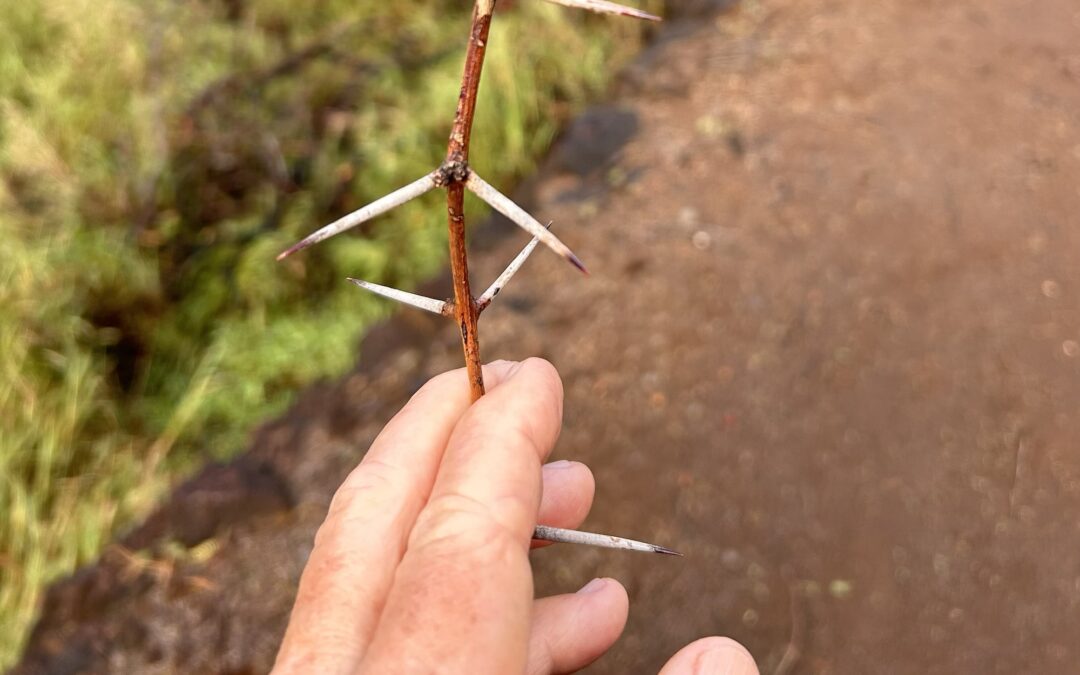
And thorns.
Good God, the thorns.
Some are nearly as long as half my little finger, hard and sharp enough to penetrate a shoe or inflict a miserable injury on an unsuspecting dog’s paw.
The shade is lovely. The thorns demand respect.
I’ve walked among these trees for years. They’ve become as familiar to me as the ocean itself.
Then came the hurricane.
Our part of Hawaiʻi Island, where hurricanes rarely make a direct appearance, found itself in the path of Lala. And the force of that storm was extraordinary.
Imagine a giant striding through the landscape, reaching down with enormous hands, twisting those ancient trees out of the ground as easily as a child might pull weeds.
Their great root systems were wrenched upward, exposed to the sky. Trees that had stood for generations lay scattered across the trail and surrounding countryside, their enormous limbs tangled together in heaps of thorny wreckage.
Much of the shade is gone now.
I have worked in the woods for many years. I own a chainsaw. I’m familiar with the effort involved in cutting enormous trunks and branches into manageable pieces.
But negotiating those kiawe thorns?
Not something I would willingly undertake.
And yet, someone must.
Walking among the wreckage this morning, I found myself thinking about the expectations we inherit simply by being born into a particular time, place, and race.
How much of what we believe ourselves to be is actually ours?
How much was planted there long before we had the means to question it?
We arrive in this world surrounded by voices telling us what is expected. Some are spoken aloud. Others come through gestures, silences, approval, disapproval. They enter through our ears and eventually become so deeply embedded that we mistake them for our own thoughts.
And perhaps nowhere has this been more apparent than in the roles assigned to men and women of all cultures.
Women have historically been expected to nurture, accommodate, anticipate the needs of others, and sometimes disappear into those needs altogether.
Men have been expected to provide, protect, remain strong, and conceal the vulnerabilities that might call their strength into question.
Both have been rewarded for fulfilling these expectations. Both have been punished for stepping outside them.
And both, I suspect, have sometimes mistaken the shelter of those roles for the whole of who they were.
After all, there is comfort in knowing what is expected of us. There is a certain security in belonging to an arrangement that has existed for generations. We inherit not only its limitations but its reassurances, the familiar shade beneath which others have lived before us.
And if the shade is pleasant enough, perhaps we learn to step carefully around the thorns.
Or to stop noticing them altogether.
I was among the women who fought for greater freedom in the 1960s and 70s. We questioned the assumptions that had governed our mothers’ and grandmothers’ lives. We challenged the notion that biology determined destiny, that our choices should be confined to roles prescribed long before we were born.
We fought hard. And we accomplished a great deal.
I think many of us believed that once those freedoms were established, the work was largely done.
But changing the rules does not necessarily change the people who have lived by them. Nor does it erase the expectations that have taken root within us.
And those roots run deep.
Consider how difficult it can be for a woman to recognize that her own desires have been buried beneath decades of accommodating others. Or for a man to discover that the strength he has spent his life cultivating may have cost him the freedom to be vulnerable.
Neither necessarily knows what lies beneath the identity they have so faithfully maintained.
And what happens when they begin to question it?
What happens when the structures that have provided us with belonging, meaning, and perhaps even love no longer accommodate the people we are becoming?
Some will cling more fiercely to what they know. Others will welcome the upheaval. And many, I imagine, will experience both impulses at once.
Because the loss of something familiar can be painful even when that something has constrained us.
I think about those great kiawe trees. I loved their shade. I admired their endurance, their capacity to flourish in a landscape that seemed to offer so little encouragement.
They were beautiful in their own fierce, uncompromising way.
And I miss them.
I don’t celebrate their destruction merely because the sky has opened above the trail. Nor can I deny that the landscape has changed, whether I welcome the change or not.
Perhaps there is something here about the difficulty of transformation, particularly when it arrives without our permission.
We like to imagine that change proceeds according to our understanding of what is necessary, that we can dismantle the old arrangements carefully, preserving what serves us while discarding what does not.
But life seldom grants us that degree of control.
Sometimes the storm arrives before we’ve decided what we’re willing to lose.
And afterward, we must confront the wreckage.
Some of us will mourn the shelter that is gone. Some will rejoice in the sunlight. Others will stand bewildered, unable to imagine what might grow in the newly exposed ground.
And the thorns?
They’re still there.
Scattered among the fallen limbs, sharp as ever, capable of wounding long after the trees themselves have been uprooted.
I wonder how many of the old expectations we continue to carry in much the same way. How often we believe we’ve freed ourselves from something, only to discover its thorns embedded in our thinking, our relationships, even our understanding of love.
Perhaps the most difficult work isn’t overturning what has stood for generations.
Perhaps it is recognizing how thoroughly we have been shaped by it.
And learning to distinguish the shelter we once needed from the thorns we no longer wish to carry.
Monday I’ll walk this trail again. The trees will still be down. Their enormous roots will remain exposed to the sky, their branches piled along the roadside.
I will miss the shade.
But I’ll also be looking at the open ground, wondering what might eventually take root there.
And who will have the courage to clear the thorns.
