
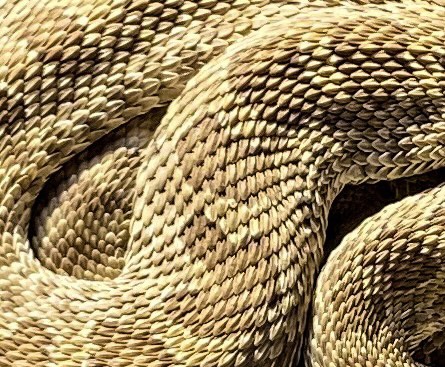
Fear is an ancient instinct, woven into every living creature to help ensure survival. Every species possesses it. The difference is that humans have the remarkable ability to extend a moment of instinct into a story—a story that can become panic, aggression, or justification. Too often, we destroy what frightens us before ever asking whether our fear is warranted.
I was reminded of this one summer afternoon in New Mexico.
After hours spent watering trees in the midsummer heat, I wandered out to the front garden and settled onto the flagstone steps. The day was cooling. Clouds were gathering. The light was beginning to soften.
Something moved in the corner of my vision.
My body startled for the briefest instant, then settled. I didn’t feed the reaction or allow it to spiral into panic. That small space between instinct and imagination is one we all possess, though many people seem to move from alarm to action in seconds.
I realized I had a visitor.
“Well, hello, friend,” I said quietly.
The prairie rattlesnake regarded me with what seemed like equal curiosity. We sat together in silence, each allowing the other time and space to adjust. We are both creatures who appreciate a respectful distance, I thought. In that way, we are not so different.
Yes, this small being possesses the power to kill.
So do I.
Neither truth needed to define the moment.
After a while, the rattler slowly withdrew its head—not to strike, but simply to change direction. It glided toward the rock wall and disappeared beneath a low shrub for the evening.
Earlier that same day, our dogs had refused to stop barking. The last time they’d behaved this way, a large bull snake had decided their hay bed made an excellent place to escape the summer heat.
Chris came from his shop while I walked over from the house. As we approached the enclosure, we heard it.
The unmistakable rattle.
If you’ve never heard one, it is unlike any other sound in nature. I’ve often imagined its message to be remarkably simple.
I am small.
I am every bit as afraid of you as you are of me.
Please give me room to decide my next move.
There it was, curled neatly in Peanut’s hay bed, bright-eyed, its rattle raised in warning.
We released the dogs toward the house, and I spent a quiet moment asking the snake to find another place to rest. An hour later, I returned to check. It was gone.
The following morning, Peanut became uneasy again. Chris rounded the corner of the house and found the rattler below a mouse clinging desperately to the rock wall above it.
For weeks we had been setting traps and searching for every tiny place rodents might enter the walls of the house.
Nature, it seemed, had provided another solution.
The snake found a meal.
We found fewer rodents.
The year before, another prairie rattlesnake had taken up residence beneath a stack of lumber after mice began chewing the wiring under our vehicles.
Many people fear snakes. Others fear spiders, sharks, jellyfish, bears, or wolves. My invitation is simply this: become curious about the origin of that fear before allowing it to determine your actions.
Our planet has already lost far too many extraordinary creatures because we assumed coexistence was impossible.
Perhaps the greater danger has never been the rattlesnake.
Perhaps it is our unwillingness to pause long enough to discover whether what frightens us is truly asking to harm us—or simply asking for enough room to live its own life.